

Big Data Analytics in Predicting Tourism Trends and Demand

Tourism demand can change quickly. A viral destination video, a canceled flight route, extreme weather, or a major event may alter traveler behavior within days. Big data analytics helps travel organizations interpret these signals and turn them into practical decisions about capacity, staffing, pricing, marketing, and destination management.
For hotels, airlines, online travel platforms, agencies, and public tourism authorities, the goal is not to predict the future with perfect accuracy. It is to create a clearer, faster view of likely demand while preserving room for human judgment and unexpected events.
Why Tourism Businesses Need Better Demand Forecasting
Tourism demand forecasting helps businesses estimate where, when, and how strongly people will travel so they can prepare resources before demand arrives. Better forecasts reduce avoidable waste while improving the visitor experience.
Traditional planning often relies on historical bookings and fixed seasonal assumptions. Those inputs remain useful, but they can miss rapid changes in travel behavior. Travelers now compare prices across channels, respond to social media trends, work remotely, and change plans in response to economic conditions or disruptions.
Seasonality creates another challenge. A beach destination may experience high demand in summer, while a ski resort depends on snow conditions and school holidays. Yet demand rarely follows the same pattern every year. A public holiday may move, an airline may add capacity, or a large concert may create an unusual spike in hotel occupancy.
External disruptions make forecasting even harder. Floods, wildfires, health alerts, strikes, geopolitical events, and currency movements can affect both arrivals and cancellations. A forecast that updates only once a quarter may become irrelevant before a planning team can act on it.
Competition also raises the stakes. If a hotel underestimates demand, it may run short of rooms, employees, or supplies. If it overestimates demand, it may discount unnecessarily and schedule more staff than required. Forecasting gives decision-makers a way to compare likely scenarios instead of relying on instinct alone.
What Data Powers Tourism Trend Prediction?
Tourism trend prediction combines historical records with current behavioral, environmental, and economic signals. The most useful systems connect several data sources rather than treating one dataset as a complete picture.
- Booking and transaction data: Reservations, cancellations, length of stay, booking windows, average transaction value, origin markets, and selected travel products reveal purchasing patterns.
- Search and website behavior: Destination searches, flight queries, accommodation views, abandoned bookings, and repeated visits can indicate rising interest before a reservation is made.
- Mobility and location data: Aggregated movement patterns can help estimate visitor flows, crowd concentration, airport demand, and changes in the popularity of attractions. These signals require strict privacy safeguards.
- Social media and sentiment analysis: Public posts, reviews, images, and comments can show how travelers perceive a destination, hotel, airline, or emerging experience.
- Weather and environmental data: Temperature, rainfall, snow conditions, storms, air quality, and climate forecasts can influence outdoor travel and cancellation risk.
- Events and transport schedules: Conferences, festivals, sports matches, school calendars, flight frequencies, rail schedules, and cruise itineraries help explain temporary demand changes.
- Economic indicators: Inflation, employment, consumer confidence, exchange rates, and fuel prices provide context for affordability and international travel decisions.
Data variety matters, but data consistency matters just as much. Booking systems may use different destination names, currencies, time zones, or customer categories. Before sophisticated modeling begins, teams need reliable definitions and a clear record of where each data point came from. The NIST Privacy Framework offers useful principles for managing privacy risk alongside data use.
How Big Data Analytics Predicts Tourism Demand
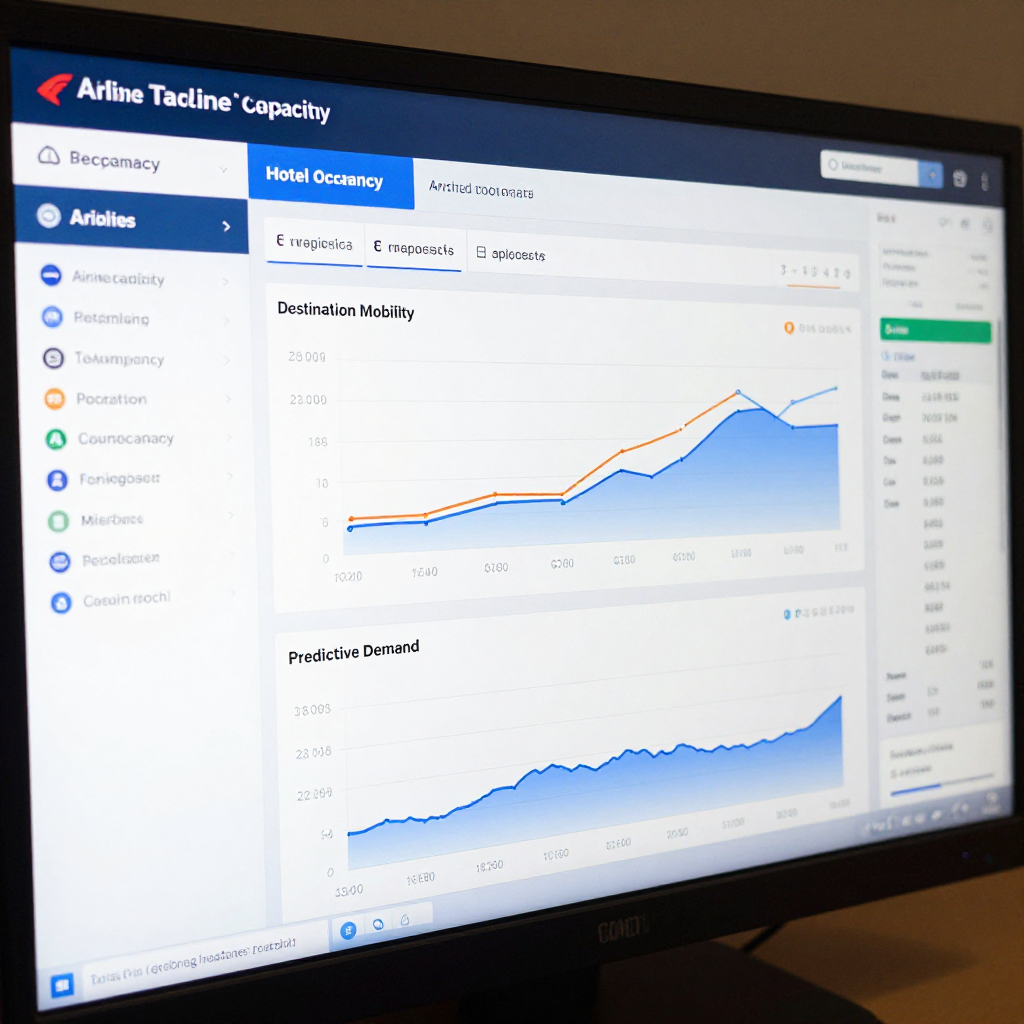
Big data analytics predicts tourism demand by processing large datasets, identifying recurring relationships, and estimating future outcomes under changing conditions. The process usually combines historical analysis, predictive models, and real-time monitoring.
From raw records to useful signals
First, data engineers collect and clean information from reservation platforms, property-management systems, airline databases, websites, mobile applications, public datasets, and social channels. They remove duplicates, handle missing values, standardize dates and locations, and separate genuine demand from technical noise.
Analysts then look for patterns. Time-series methods can identify seasonality, growth, booking lead times, and recurring peaks. Machine learning models can compare many variables at once, such as price, weather, flight capacity, search activity, and local events. The result may be a forecast of room nights, passenger volumes, attraction visits, or cancellation probability.
Prediction needs interpretation
Sentiment analysis adds qualitative context by classifying public comments as positive, negative, or neutral and identifying topics such as cleanliness, safety, congestion, or service quality. A rise in destination searches may appear promising, but negative sentiment about overcrowding could signal a different management priority.
Real-time monitoring allows organizations to compare actual performance with forecast demand. If flight searches rise sharply after a new route announcement, a destination can review transport capacity and visitor communications. If cancellations increase after a weather warning, hotels can adjust staffing and inventory plans.
Forecasts should be expressed as ranges or scenarios where possible. A base case, high-demand case, and disruption case are often more useful than one apparently precise number. This approach acknowledges that predictive analytics reduces uncertainty; it does not eliminate it.
Applications Across the Travel Industry
Across the travel industry, predictive analytics turns demand estimates into decisions about capacity, inventory, staffing, pricing, and communication. Each organization uses the same signals differently.
Airlines and airports
Airlines can forecast passenger demand by route, departure date, cabin, and origin market. These insights support aircraft scheduling, crew planning, route evaluation, ancillary offers, and dynamic pricing. Airports can use passenger forecasts to plan security staffing, gate allocation, retail capacity, and ground transport.
Hotels and accommodation providers
Hotels use booking pace, cancellation behavior, local events, competitor rates, and historical occupancy to manage room inventory. Revenue teams may adjust prices by room type and date, while operations teams schedule housekeeping and front-desk staff according to expected arrivals and departures. A forecast can also guide purchasing for food, amenities, and other supplies.
Destinations and public authorities
Destination management organizations can combine visitor counts, mobility patterns, accommodation data, and sentiment analysis to identify congestion and underserved areas. They may promote alternative attractions, improve public transport, stagger communications, or invest in infrastructure before pressure becomes severe. This makes forecasting a planning tool, not merely a marketing function.
Travel agencies and online platforms
Travel agencies and online travel platforms can use search behavior and transaction data to personalize recommendations, identify emerging destinations, and time campaigns more effectively. Forecasts may support package design, supplier negotiations, customer service staffing, and alerts about price or availability changes.
Benefits of Data-Driven Tourism Forecasting
Data-driven tourism forecasting improves coordination by connecting expected demand with the resources needed to serve it. Its value appears in operations, customer experience, financial planning, and destination policy.
- Better resource allocation: Hotels can align staffing and supplies with expected occupancy, while airports and attractions can prepare for visitor peaks.
- More relevant experiences: Travel platforms can recommend suitable products and destinations based on changing interests, availability, and trip context.
- Reduced operational waste: More accurate planning can limit overstaffing, unused inventory, unnecessary transport capacity, and avoidable food or energy consumption.
- Faster response to trends: Real-time signals can reveal growing interest in a destination or a sudden fall in demand sooner than monthly reports.
- Improved revenue decisions: Dynamic pricing can reflect demand conditions while managers monitor fairness, customer reaction, and long-term brand effects.
There is a practical trade-off. More data can improve visibility, but it also increases integration costs, governance demands, and the risk of confusing correlation with causation. A smaller, trusted dataset tied to a clear business question may produce more value than a huge collection no team can interpret.
Challenges and Responsible Use of Tourism Data
Responsible tourism analytics requires accurate data, secure systems, transparent practices, and human oversight. Forecasting becomes risky when organizations treat a model output as objective truth.
Data quality is a common weakness. Incomplete booking records, inconsistent channel reporting, bot traffic, delayed mobility feeds, and biased review samples can distort results. Models also struggle with rare events because historical data contains few examples of unprecedented disruptions.
Privacy requires particular care. Location data, browsing behavior, loyalty records, and transaction histories may reveal sensitive information, even when individual names are removed. Travel companies should define a legitimate purpose, collect only what they need, provide meaningful notice, apply access controls, and respect applicable data-protection laws such as the Federal Trade Commission guidance on privacy and security.
Security controls should cover collection, storage, processing, sharing, and deletion. Encryption, role-based access, vendor reviews, retention limits, and incident-response procedures reduce exposure. Consent should never be treated as a one-time checkbox when data uses change substantially.
Bias is another concern. A model trained on affluent international travelers may underrepresent local visitors, budget travelers, people with limited digital access, or less visible markets. Teams should test performance across relevant segments and document known limitations.
Three mistakes appear frequently:
- Using every available data source: Teams collect more information than they can validate, increasing cost and noise. Start with variables connected to a specific decision.
- Optimizing only for short-term revenue: Aggressive pricing or targeting may damage trust and worsen overcrowding. Include customer experience and destination capacity measures.
- Removing human review: A forecast may miss a new disruption or reflect a biased sample. Give experienced operators authority to challenge and contextualize model results.
How Travel Organizations Can Build a Practical Analytics Strategy
To build a practical tourism analytics strategy, organizations should connect one measurable business goal to trusted data, a tested forecast, and a defined operational action. A staged approach keeps technology useful and manageable.
- Define the decision: Choose a concrete question, such as expected room nights next month, airport passenger volume during an event, or likely cancellation levels after a weather warning.
- Map relevant data: Combine historical demand with current signals such as booking pace, search activity, events, weather, pricing, and transport capacity. Document ownership, quality, permissions, and update frequency.
- Establish governance: Set rules for privacy, consent, retention, security, access, model documentation, and escalation when results appear unreliable.
- Test a suitable model: Compare a simple baseline with more advanced predictive analytics. Measure accuracy using historical holdout periods and evaluate performance during unusual conditions.
- Link forecasts to action: Specify who changes staffing, pricing, inventory, communications, or destination operations when a forecast crosses an agreed threshold.
- Measure business outcomes: Track forecast error, response time, occupancy, cancellations, service levels, waste, revenue quality, and customer or resident sentiment.
- Refine continuously: Review failures, add relevant signals, retrain models when behavior changes, and retire variables that create noise or unnecessary privacy risk.
Small travel businesses can begin with clean reservation data, spreadsheet-based trend analysis, and a simple dashboard before investing in complex machine learning. The strongest foundation is a repeatable decision process, not the most expensive platform.
Frequently Asked Questions
What types of data are used to predict tourism demand?
Common sources include booking and transaction data, search behavior, website interactions, mobility data, social media sentiment, weather, events, transport schedules, and economic indicators. Combining sources usually provides more context than relying on bookings alone.
How accurate are tourism demand forecasts?
Accuracy varies by destination, time horizon, data quality, and market stability. Short-term forecasts may respond well to current booking signals, while long-range forecasts face greater uncertainty. Organizations should report error ranges and update forecasts as new information arrives.
How can small travel businesses use big data analytics?
They can start by analyzing booking pace, cancellations, lead times, local events, competitor availability, and website searches. A focused dashboard and monthly review may be sufficient before adopting advanced predictive models.
How does predictive analytics support destination management?
It helps authorities anticipate visitor flows, identify congestion, plan transport and staffing, distribute demand across attractions, and communicate with visitors. Responsible use also considers residents, environmental capacity, and the quality of local services.
What privacy risks should travel companies consider?
Key risks include excessive collection, unclear consent, re-identification of location data, unauthorized access, insecure vendors, long retention periods, and biased profiling. Privacy-by-design controls should be included before data is used for forecasting or personalization.
Big data analytics gives travel organizations a stronger way to understand tourism trends and prepare for demand, provided they connect forecasts to real decisions. The most durable strategy combines historical evidence, real-time signals, transparent governance, and professional judgment. That balance helps businesses respond faster while protecting traveler trust and destination resilience.