


How Blockchain Is Revolutionizing Hotel Bookings and Security in Modern Tourism
The Problem With Traditional Hotel Booking Systems
Traditional hotel booking systems are riddled with inefficiencies that cost both travelers and hoteliers time and money. The current infrastructure relies heavily on intermediaries, fragmented databases, and outdated security protocols — creating friction at almost every stage of the guest journey.
Online Travel Agencies (OTAs) like Booking.com and Expedia typically charge hotels commission fees ranging from 15% to 30% per reservation. That's a significant cut, and hotels often compensate by inflating room rates — meaning guests rarely get the best deal available. Meanwhile, the hotel loses margin it could reinvest in improving the guest experience.
Security is an equally pressing concern. Centralized booking databases are attractive targets for cybercriminals. The 2018 Marriott data breach exposed the personal information of approximately 500 million guests — one of the largest hospitality breaches ever recorded. Credit card details, passport numbers, and contact data were all compromised. This wasn't an isolated incident; the hospitality sector consistently ranks among the most frequently targeted industries for payment fraud and identity theft.
Booking disputes add another layer of frustration. When a guest claims a cancellation was submitted and the hotel has no record of it, resolving the disagreement depends entirely on manual processes and goodwill — neither of which scales well. These pain points collectively make a compelling case for a fundamentally different approach.
What Blockchain Brings to the Hospitality Table
Blockchain is a distributed ledger technology (DLT) that records transactions across a network of computers rather than storing data in a single, centralized location. Each record — or "block" — is cryptographically linked to the previous one, creating a chain that is practically impossible to alter without detection.
Three properties make blockchain particularly relevant to hospitality:
- Decentralization: No single entity controls the data. Hotels, guests, and payment processors all interact with the same shared record.
- Immutability: Once a booking or transaction is recorded, it cannot be changed retroactively. This eliminates disputes over what was agreed.
- Smart contracts: Self-executing programs stored on the blockchain that automatically enforce the terms of an agreement — no middleman required.
For a tourism audience, the practical translation is straightforward: blockchain creates a system where records are transparent, tamper-proof, and automated. That's a meaningful upgrade from the patchwork of spreadsheets, third-party platforms, and manual reconciliations that many property management systems (PMS) still rely on today.
Streamlining Bookings: Cutting Out the Middleman
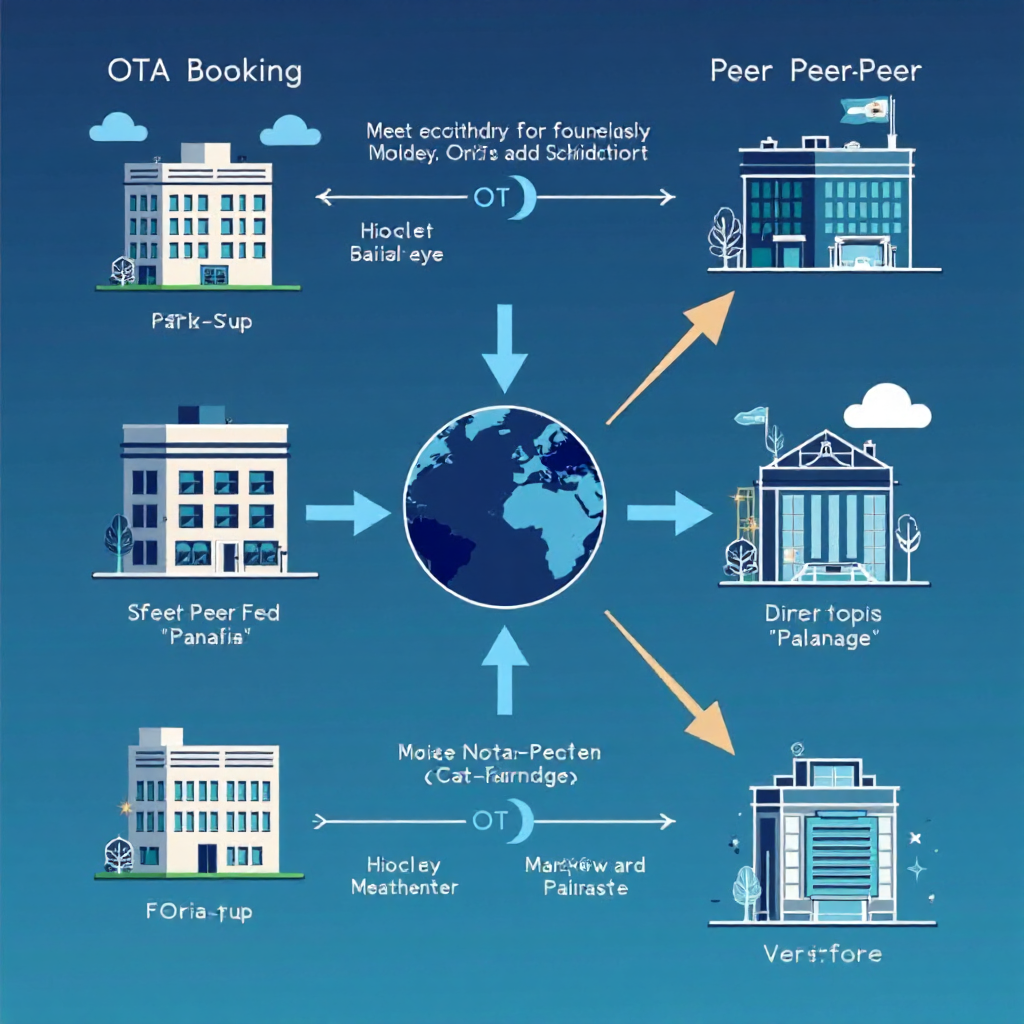
Blockchain-powered booking platforms enable direct, peer-to-peer reservations between hotels and travelers — reducing or eliminating the need for OTA intermediaries. The financial implications are significant: hotels can offer lower rates while maintaining or improving their own margins.
Projects like Winding Tree, an open-source travel distribution platform built on blockchain, have demonstrated this model in practice. Airlines and hotels can list inventory directly on a decentralized marketplace, where any developer or travel agent can access and sell it without paying licensing fees to a central gatekeeper.
For travelers, the benefit is pricing transparency. When a hotel lists a room directly on a blockchain-based platform, the rate shown reflects actual cost — not a price inflated to cover OTA commissions. The booking record itself is also visible and verifiable, reducing the risk of fraudulent listings that plague some third-party platforms.
Tokenization plays a supporting role here too. By accepting cryptocurrency payments, hotels can process international transactions without currency conversion fees or banking delays — a genuine advantage for properties serving global guests.
Smart Contracts: Automating Trust Between Hotels and Guests
Smart contracts are self-executing agreements written in code and stored on a blockchain. When pre-defined conditions are met, the contract executes automatically — no human approval needed.
Applied to hotel reservations, the implications are practical and immediate. A smart contract can be programmed to:
- Release a room deposit to the hotel upon check-in confirmation
- Trigger an automatic refund to the guest if the hotel cancels within a specified window
- Enforce cancellation policies without requiring a guest service agent to process each case manually
- Resolve disputes by referencing the immutable booking record stored on the distributed ledger
Consider a common scenario: a guest books a non-refundable rate but experiences a flight cancellation. Under traditional systems, negotiating any form of refund involves emails, phone calls, and manager discretion. With a smart contract, the terms are encoded upfront — both parties know exactly what happens under what conditions, and the outcome is executed automatically.
This doesn't just save time. It builds trust. Guests who know the terms are enforced by code rather than policy documents are less likely to dispute charges, and hotels spend less on manual resolution processes. A 2023 report by Deloitte on hospitality operations noted that dispute resolution and manual reconciliation can consume 8-12% of front-desk staff hours — a cost that smart contract automation could substantially reduce.
Strengthening Security: Protecting Guest Data and Payments
Blockchain's encrypted, distributed architecture makes it fundamentally harder to breach than centralized hotel databases. Because guest data is spread across thousands of nodes rather than stored in a single server, there is no single point of failure for attackers to exploit.
Digital identity verification — often called KYC (Know Your Customer) in financial contexts — is one of the most promising security applications. Instead of submitting passport scans to multiple booking platforms (each of which stores your data indefinitely), a blockchain-based identity system lets travelers verify their identity once and share cryptographic proof with hotels on demand. The hotel confirms you are who you say you are without ever storing your raw personal data.
Payment security gets a similar upgrade. Blockchain transactions use asymmetric encryption and require private key authorization, making unauthorized charges significantly harder to execute than traditional card-based payments. For hotels, this reduces chargebacks and payment fraud — two chronic revenue leakage problems in the sector.
The immutability property also serves a compliance function. Regulatory frameworks like GDPR require hotels to demonstrate exactly how and when guest data was accessed or modified. A blockchain audit trail provides that record automatically, without requiring hotels to build expensive custom logging systems.
Blockchain-Powered Loyalty Programs and Tokenized Rewards
Hotel loyalty programs are ripe for disruption. Most current schemes suffer from the same structural problems: points expire, redemption options are limited, and transferring rewards between brands is nearly impossible. Blockchain changes the underlying architecture of how loyalty value is created and stored.
Using reward tokens issued on a blockchain, hotels can create loyalty currencies that guests actually own — stored in a digital wallet rather than a proprietary database. These tokens can be made interoperable, meaning a guest could potentially use hotel reward tokens to pay for a flight, a restaurant booking, or a local experience, depending on which partners have joined the network.
Fraud, which costs loyalty programs an estimated $1 billion annually according to industry analysts, is also easier to prevent. Because every token issuance and redemption is recorded on an immutable ledger, duplicate rewards, fake accounts, and point manipulation become detectable in real time.
Some hotel groups are already experimenting here. While large-scale deployments remain limited, pilot programs in Asia and Europe have tested tokenized rewards that guests can trade or spend across partner networks — a model that traditional points systems cannot replicate without massive infrastructure investment.
Challenges and the Road Ahead for Blockchain in Tourism
Blockchain adoption in hospitality is real but uneven. The technology's potential is clear; the path to industry-wide implementation is not.
Several barriers remain significant:
- Scalability: Public blockchain networks can process only a limited number of transactions per second. During peak booking periods, this creates latency issues that hotel systems cannot tolerate.
- Regulation: Cryptocurrency payments and tokenized assets operate in a regulatory grey zone in many countries. Hotels adopting these systems face compliance uncertainty.
- Standardization: For blockchain to deliver interoperability across the hospitality industry, hotels, OTAs, airlines, and payment processors need to agree on common protocols. That kind of coordination takes years.
- Integration costs: Connecting blockchain solutions to existing property management systems requires significant technical investment — a barrier for independent hotels and smaller chains.
None of these challenges are insurmountable, but they explain why blockchain in hotel booking remains largely in the pilot and proof-of-concept phase for most operators. The technology is maturing rapidly, and enterprise-grade solutions designed specifically for hospitality are emerging. The question for hotel operators isn't whether blockchain will matter — it's when the adoption curve reaches critical mass.
For travelers, the near-term experience will likely be invisible: blockchain working behind the scenes to make bookings more secure and refunds more automatic, without requiring any change in how you search or book. That's probably how transformative infrastructure should work.
Frequently Asked Questions
Is blockchain technology already being used by major hotel chains?
Yes, selectively. Several major chains and travel platforms have run pilot programs using blockchain for loyalty programs, identity verification, and direct booking. Full-scale deployment across the industry is still developing, but the technology is no longer purely theoretical in hospitality.
How does blockchain protect my personal data when I book a hotel?
Blockchain-based identity systems allow you to verify your identity cryptographically without sharing raw personal data with the hotel. Your information isn't stored in a centralized database that could be breached — instead, the hotel receives a verified confirmation without retaining your actual documents.
Can I pay for hotel bookings with cryptocurrency using blockchain platforms?
Some hotels and blockchain-based booking platforms do accept cryptocurrency payments. Adoption is growing but remains limited to tech-forward properties and platforms. Stablecoins (cryptocurrencies pegged to fiat currency) are increasingly preferred for travel payments because they eliminate exchange rate volatility.
What is a smart contract and how does it apply to hotel reservations?
A smart contract is a self-executing program stored on a blockchain that automatically carries out agreed terms when specific conditions are met. For hotel reservations, this means automated check-in confirmations, refunds, and cancellation enforcement — without requiring manual processing by hotel staff.
Will blockchain replace traditional hotel booking platforms like Booking.com or Expedia?
Not in the near term. Decentralized booking platforms face significant adoption hurdles, and OTAs offer marketing reach that most hotels cannot replicate independently. A more likely outcome is a hybrid model where blockchain-based tools reduce OTA dependency over time, rather than eliminating these platforms entirely.